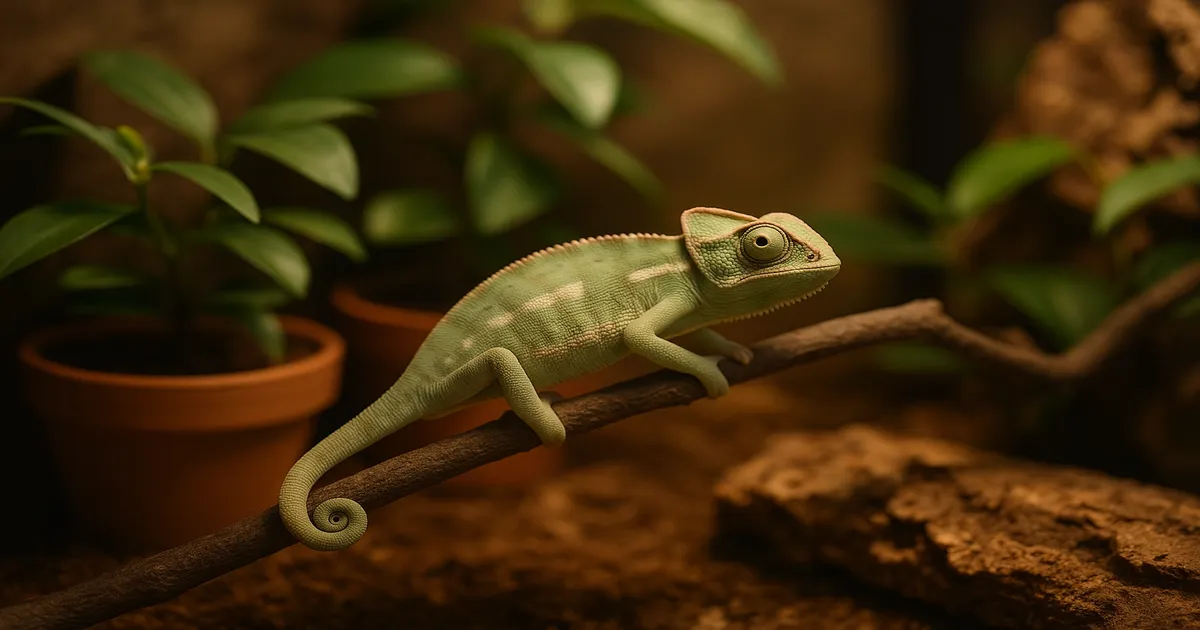
Quick Answer: Feed a juvenile female veiled chameleon 8–12 appropriately sized feeder insects per session, 5–6 days per week — not every single day. Prey should be no larger than the width of her head between the eyes, and uneaten insects should be removed within 30–45 minutes. For female veileds specifically, controlled feeding isn’t just good practice — it’s what keeps her alive long-term.
If you’ve been Googling “how much should I feed a juvenile female veiled chameleon each day,” you’ve probably already noticed that the answers vary wildly. Some sources say feed daily, some say every other day, some throw out a cricket count with zero context. The truth is more nuanced — and for female veileds in particular, getting this right matters more than most keepers realize when they’re starting out.
How Much to Feed a Juvenile Female Veiled Chameleon Each Day
The Core Feeding Rule
For juveniles between 2 and 6 months old: 8–12 appropriately sized feeders per session, 5–6 days per week. That means one or two fasting days built into every week — not as punishment, but as a deliberate part of the schedule.
Prey sizing follows the head-width rule: no feeder insect should be longer than the space between your chameleon’s eyes. At 2–3 months, that’s roughly ¼-inch (6mm) crickets or small dubia nymphs. By 4–6 months, you can move up to ⅜–½-inch (9–12mm) prey.
Why Female Juveniles Have Unique Feeding Needs
Here’s where a lot of keepers get caught off guard. Female veiled chameleons can develop follicles — the precursor to egg production — without ever being near a male. Overfeeding accelerates growth, and faster growth means earlier sexual maturity. A female pushed to maturity at 4–5 months through daily heavy feeding can start producing infertile egg clutches before her body is remotely ready. That leads to egg-binding, calcium depletion, and death — sometimes before she’s even a year old.
Controlled, moderate feeding isn’t deprivation. It’s the single most protective thing you can do for a juvenile female veiled chameleon.
Feeding Quantities and Frequency by Age
Prey Count Per Session
Offer 8–12 insects per feeding session. This is a guideline, not a hard ceiling — a 2-month-old and a robust 6-month-old aren’t the same animal. Use body condition as your calibration tool. If she’s looking barrel-shaped, pull back. If she’s hunting hard and finishing every insect in under 10 minutes, you’re probably in the right range.
Prey Sizing by Age
The head-width rule is simple: no feeder should be longer than the distance between your chameleon’s eyes. Prey that’s too large causes regurgitation, choking, and impaction — all avoidable.
- 2–3 months: ¼-inch (6mm) crickets or small dubia nymphs
- 4–6 months: ⅜–½-inch (9–12mm) crickets or small-to-medium dubia nymphs
She’s growing fast, so measure your prey against her regularly. The right size this week might be too small in three weeks.
Why 5–6 Days Per Week Beats Daily Feeding
Daily feeding without any break is the most common mistake I see with juvenile female veileds. Building in one or two fasting days per week mirrors the natural variability of food availability in Yemen and Saudi Arabia — where wild veileds experience distinct wet and dry seasons — and prevents the metabolic overdrive that drives early reproductive cycling. Stick to the schedule even when she’s acting hungry. And she will act hungry, because veiled chameleons are famously food-motivated.
One Session or Two?
Some experienced keepers split the daily ration into two small sessions of 5–6 insects rather than one larger sitting. This can reduce gorging behavior and gives you more time to observe hunting accuracy and appetite. Either approach works — just don’t let the total insect count creep above 12 per day, and always remove uneaten feeders within 30–45 minutes.
Best Feeder Insects for Juvenile Female Veiled Chameleons
Staple Feeders
These three form the backbone of a solid rotation:
- Crickets (Acheta domesticus or Gryllus bimaculatus) — widely available, good movement stimulus, solid protein source when gutloaded well
- Dubia roaches — higher protein than crickets, softer exoskeleton, less chitin; excellent for juveniles
- Black soldier fly larvae (BSFL / Phoenix worms) — naturally high in calcium with a favorable calcium-to-phosphorus ratio of roughly 1.5:1; one of the few feeders you don’t need to dust with calcium at every feeding
Supplemental Feeders
Silkworms are honestly one of the best things you can add to a juvenile female’s diet. They’re calcium-rich, highly digestible, and almost universally accepted. I try to work them in two or three times a week when I can source them. Hornworms are useful primarily as a hydration tool — offer one or two per week if your chameleon seems mildly dehydrated (sunken eyes, darker-than-normal coloration) — but don’t overdo it, since their high water content dilutes nutritional density. Blue bottle fly pupae add behavioral enrichment and are eagerly chased; a nice treat a couple of times per week.
Occasional Treats
Waxworms and butterworms are high in fat and should be limited to once a week at most — especially for females, where excess fat storage contributes to reproductive complications. Think of them as candy: fine occasionally, problematic as a regular offering.
Feeders to Avoid
- Mealworms: High chitin content, poor nutrition, real impaction risk for juveniles
- Superworms: Too large and too aggressive — they can bite back
- Wild-caught insects: Pesticide and parasite risk isn’t worth it
Gutloading and Supplementation
Gutloading Is Non-Negotiable
A chameleon’s nutritional status is only as good as what its feeders ate. Crickets kept on egg carton with no food for two days are nutritionally empty. Gutload your insects for 24–48 hours before offering them, using collard greens, dandelion greens, squash, carrots, or mustard greens. A quality commercial gutload like Repashy Bug Burger works well and is a solid choice for keepers who don’t want to maintain a constant supply of fresh produce.
Supplementation Schedule for Juvenile Females
- Calcium without D3: Light dusting at every feeding
- Calcium with D3: Twice per month — if you’re running proper UVB (a linear T5 HO bulb such as an Arcadia 6% or Zoo Med Reptisun 5.0 is the standard for veileds), the lamp is already driving D3 synthesis, so you don’t need to supplement it heavily
- Multivitamin: Once per month for juveniles — Repashy Calcium Plus LoD is a popular all-in-one option that avoids the need to manage separate supplements
Avoid preformed vitamin A (retinol) in your multivitamin — it causes hypervitaminosis A in chameleons. Stick to beta-carotene-based formulas.
The Calcium Demands of Female Veileds
Egg production depletes calcium reserves at a rate that genuinely shocks new keepers. A female that goes into her first reproductive cycle already calcium-deficient is at serious risk of metabolic bone disease and dystocia. Starting calcium supplementation consistently from day one isn’t optional — it’s the foundation of keeping a female veiled alive long-term.
Common Feeding Mistakes That Harm Juvenile Female Veiled Chameleons
Overfeeding Every Day
Veiled chameleons will act hungry essentially all the time. That’s their nature — don’t interpret it as a signal to keep feeding. The chain from overfeeding to death is well-documented: rapid growth → early follicle development → egg-binding → death. It happens fast, and it happens to chameleons that looked perfectly healthy a month earlier.
Prey That’s Too Large
Regurgitation is stressful and physically taxing for a juvenile. Impaction is worse. Measure your prey. The head-width rule exists because it works.
Poorly Gutloaded Insects
You can feed the right number of insects and still produce a nutritionally deficient animal if those insects haven’t been gutloaded. This is the mistake that flies under the radar the most — everything looks fine until it isn’t.
Leaving Uneaten Feeders in the Enclosure
Crickets will bite a sleeping chameleon. I’ve seen the wounds — they’re not trivial. Remove everything uneaten within 30–45 minutes, every time. A feeder cup makes this much easier to manage; the Lugarti Feeder Cup is a keeper favorite for good reason.
Relying on a Single Feeder Species
A cricket-only diet, even with excellent gutloading and supplementation, doesn’t provide the full amino acid and fatty acid profile that a varied rotation does. Rotate your feeders. It’s one of the easiest improvements you can make.
Pro Tips for Feeding Juvenile Female Veiled Chameleons
Keep Her Lean and Interested
The goal is an animal that’s alert, actively hunting during feeding sessions, and showing genuine interest in food — not one that’s gorging herself daily. Slightly less than maximum feeding genuinely extends lifespan in female veileds. This is counterintuitive when you’re new to the hobby, but it’s one of the most consistent pieces of advice from experienced kemeleon keepers.
Use a Feeder Cup to Track Intake
Training your juvenile to eat from a feeder cup early on lets you count exactly how many insects she consumes per session. A sudden drop in appetite is often the first sign of illness, stress, or early follicle development — and you’ll only notice it if you’re tracking intake consistently.
Read Her Body Condition
A healthy juvenile female has a gently convex lateral profile — no visible ribs, no barrel-shaped abdomen. Photograph her from the same angle every week. Visual comparison over time is far more useful than any single observation.
Watch for Early Follicle Development
Around 4–6 months, watch for slight abdominal swelling. If you see it, reduce feeding to 4–5 days per week immediately and make sure calcium supplementation is consistent. Set up a laying bin — a container of moist sand or topsoil at least 12 inches (30cm) deep — before she needs it. A female that can’t find a suitable laying site will become egg-bound, and that’s an emergency vet visit at best.
Frequently Asked Questions
How many crickets should I feed a juvenile female veiled chameleon per day?
Offer 8–12 crickets per feeding session, 5–6 days per week. At 2–3 months, use ¼-inch (6mm) crickets; at 4–6 months, move up to ⅜–½-inch (9–12mm). Always remove uneaten crickets within 30–45 minutes.
What happens if you overfeed a juvenile female veiled chameleon?
Overfeeding drives rapid growth, which triggers early sexual maturity and follicle development — sometimes as young as 4–5 months. This leads to early egg production, calcium depletion, egg-binding (dystocia), and can be fatal. Female veileds will act hungry even when well-fed, so their behavior isn’t a reliable guide to how much food they actually need.
What is the best feeder insect for a juvenile female veiled chameleon?
Variety is the point — no single feeder is “best.” That said, dubia roaches and silkworms are standouts: dubia for their protein and soft exoskeleton, silkworms for their calcium content and digestibility. Black soldier fly larvae are also excellent for their naturally favorable calcium-to-phosphorus ratio. Rotate all three as staples.
When should I start worrying about egg production in my juvenile female?
Start paying attention around 4 months. If you notice any abdominal swelling, reduce feeding frequency immediately to 4–5 days per week and set up a laying bin with moist sand or topsoil at least 12 inches (30cm) deep. Egg production in a chameleon under 9–12 months is a sign that feeding has been too aggressive — but once follicles are developing, your focus shifts to supporting her safely through it.